
It’s an interesting word. Passion literally means “strong and barely controllable emotion.” We often pair it with a goal to achieve, a driving force, or romantic love. But that’s not what I witnessed at my house this weekend.
Heading into Easter, my youngest and I watched Mel Gibson’s The Passion of the Christ, starring Jim Caviezel as Jesus of Nazareth. It was my third time experiencing the movie, and it affected me no less than the previous two showings (one in a theater and one on a Christmas Eve a long time ago with Amy and her parents).

We had just been reading the Easter story in our morning devotions this week when I suggested to my son that we watch it. Knowing how it affected me, I should not have been surprised at my son’s visceral passion as he put voice to his confusion, grief, and passion. I can still hear him screaming at the Roman guards and at Caiaphas, the High Priest.
Each viewing, my body has reacted violently to every crack of the cane and whip, each lash of the cat-of-nine-tails, and every jarring fall under the weight of the Cross. It astounds me that the brutality depicted in the movie was “toned down” to receive an “R” rating. The violent handling of my Lord and Maker was much worse than depicted in the movie… and what I witnessed in the movie left me physically ill.
Each time I’ve watched that movie I’ve been struck by many things, but a different one seems to hang onto me for hours and days after the viewing. The first time I watched it the epiphany that Mary most likely watched each painful step of her son’s excruciating crawl down the Via Dolorosa. She also felt each smack of the hammer as it struck the spikes. When Mary’s memory takes the story back to a time when Jesus, as a little boy, falls, she runs to him to comfort him. I was undone. Watching her seemingly stare down Satan seconds later shows a determination, and resignation, I never ascribed to the Virgin Mother.
The second time I watched it, finishing in the wee hours of Christmas morning, I was struggling for breath when I realized the symbolism of God the Father crying. The dad in me was again undone, filleted by the deeper understanding of God the Father. It was then that I began referring to The Father as Abba. I finally saw His “daddy’s heart” after so many years of only viewing him akin to Zeus.
This time watching the epic was much different than the last two viewings. Those were marked by an eerie quiet with an undertone of quiet sobbing and nearly silent sniffing. My son’s reaction could not be contained like so many adults. He was so enraged by Caiaphas, Pilot, and the Roman soldiers.
“How can they do that?”
“Can’t they see they are killing him?!?”
“How could you be so evil?”
“This is all your fault!”
My son’s jabs were hurled at a deaf television while the characters continued on without acknowledging him. I, however, was neither deaf nor blind to him. His sobs could not be muted. His cries could not be ignored. His flinches could not be unheard.
When the scene where Mary tries to comfort her bloodied son came on screen, I heard wailing, bolstered by a realization…or maybe it was a new understanding that only the grief my little one has wrestled with of late could comprehend.
This daddy’s heart was rent, watching my youngest wrestle with some of the same “strong and barely controllable emotion” I never understood until I was at least twice his age.
The global church has done a good job romanticizing the event and the weapon of such
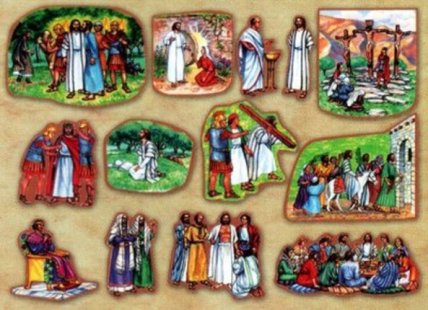
demonic physical and mental torture. Do I understand, yes… and no. Watching such a visceral depiction of something I was originally taught on a flannel graph in Sunday School made me feel cheated… actually, no, I felt ashamed because I never understood the depths of pain and agony Yeshua allowed Himself to receive at the hands of wicked men so that I could be saved. Can children handle the level of violence this event held, no, but somewhere along the road, I feel as if I should have realized, or been shown, just how wholly evil, brutal, and wicked this event truly was. I can no longer look at the symbol of the cross without replaying the violence in my head. I am so ever grateful for the sacrifice of my Lord and Savior. May I never again romanticize the event as a thing of beauty.



 Good Grief?!?